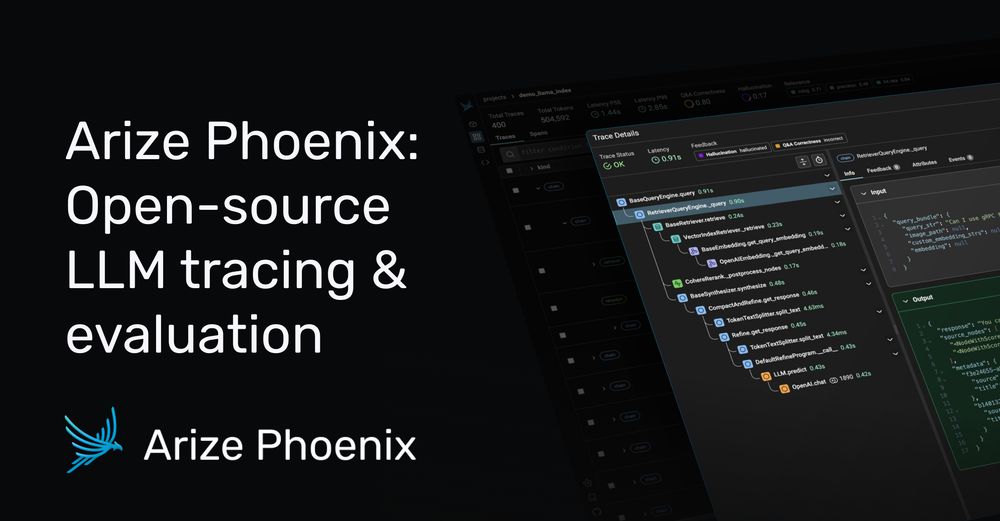
Self-hosted LLM and agent tracing, evals and experiments built on OpenTelemetry, free to run under the Elastic License 2.0 with no usage caps.
Teams that want no vendor in the data path. Phoenix runs locally with pip install arize-phoenix and phoenix serve, or on your own infrastructure with PostgreSQL via Docker, a Kubernetes Helm chart or Docker Compose, and the self-hosting docs state it can run air-gapped with no licence fees, usage limits or feature gates. Because tracing is OpenTelemetry-based and auto-instrumentation comes from the separate OpenInference project, the instrumentation you write is portable to any OTel backend - which makes Phoenix a sensible default for polyglot shops, given it covers Python, JavaScript, Java and Go.
Do not treat Phoenix as open source in a procurement sense. It is licensed under the Elastic License 2.0, not an OSI licence: you may not provide the software to third parties as a hosted or managed service where that service gives users access to any substantial set of its features, you may not move, change, disable or circumvent the licence key functionality, and you may not remove or obscure licensing notices. The README also states that some code is patent protected and points to an IP_NOTICE file. Operationally, self-hosting means you own PostgreSQL, storage, upgrades, backups and retention - Arize's own material states retention is managed by your team, so there is no managed retention policy to lean on. If you want the hosted version, the path is Arize AX, where the free tier is 25,000 spans a month with 15-day retention and Pro at $50/month is 50,000 spans with 30-day retention, and no per-span overage rate is published for either.
Pros
Cons
It is free and self-hostable, but the licence is the Elastic License 2.0, which is not OSI-approved. ELv2 prohibits providing the software to third parties as a hosted or managed service where that service gives users access to any substantial set of its features, prohibits moving, changing, disabling or circumventing the licence key functionality, and prohibits removing or obscuring licensing notices. The README also states some code is patent protected.
The self-hosting documentation states there are no licence fees, no usage limits and no feature gates, and names tracing, evals, datasets, experiments and prompt management as included. Authentication is documented as OAuth2, LDAP or local accounts, with role-based access controls. The deployment can run air-gapped. What you take on in exchange is PostgreSQL, object storage, upgrades, backups and your own retention policy.
It is built on it. The README describes Phoenix as built on top of OpenTelemetry and vendor-, language- and framework-agnostic, with runtime tracing done through OpenTelemetry-based instrumentation. Auto-instrumentation lives in the separate OpenInference project, and the same OpenTelemetry and OpenInference instrumentation feeds both Phoenix and Arize AX, so the spans you emit are not locked to either destination.
Phoenix is the free, local-first, self-hosted platform under ELv2. Arize AX is the commercial managed product and is priced per span: AX Free is $0 with 25,000 spans a month, 1 GB storage and 15-day retention; AX Pro is $50 a month with 50,000 spans, 10 GB and 30-day retention; AX Enterprise is custom and is the only plan offering Arize-supported self-hosted deployment. Both share the same instrumentation.
Facts sourced from the vendor’s own site, last verified 2026-10-10.
The Weekly Source
One email a week. New listings, repriced tools, and the ones we would skip - including this one if its pricing changes.