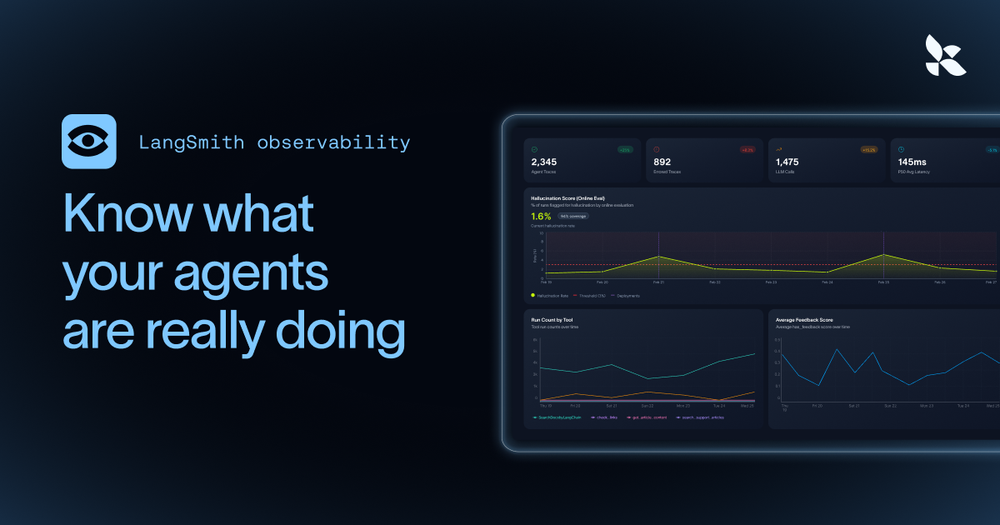
LangChain's hosted tracing, evals and monitoring for LLM apps; Developer tier is $0 with 5k base traces a month and 14-day base retention.
Teams already building on LangChain or LangGraph, where tracing is close to free to wire up and the evaluation and annotation tooling sits alongside the agent runtime. It also works for stacks that have nothing to do with LangChain, because LangSmith publishes an OTLP/HTTP endpoint and the docs describe running an OpenTelemetry Collector that fans the same spans out to LangSmith and to Datadog, Honeycomb or Grafana. Useful for teams that want online evaluators and automation rules running against production traffic without building that scheduling themselves.
Anyone who needs to forecast a bill before committing: the pricing page states only "pay as you go thereafter" and publishes no dollar rate per trace for base traces or for extended-retention upgrades, so the real cost at volume is unknowable from public material. Retention is the sharpest limit - base traces are kept 14 days, and extended retention is capped at 180 days for SaaS customers from 14 September 2026, charged as a base trace plus a separate extended upgrade line. Worse for budgeting, upgrades happen automatically: any online evaluator run on a trace, an automation rule, or feedback sent with extend_trace_retention=true silently promotes a base trace to the more expensive extended tier. Self-hosted and hybrid deployment, custom SSO and ABAC are Enterprise-only, and the Developer plan is hard-limited to a single seat.
Pros
Cons
LangChain does not publish a per-trace rate. The pricing page lists 5,000 base traces a month on Developer and 10,000 on Plus, then says usage beyond that is pay as you go, billed monthly in arrears. Extended-retention traces cost more than base traces but the surcharge is not published either. You can see consumption in the usage views, but you cannot model the bill from public pricing alone.
Retention attaches to the trace rather than the plan. Base traces are kept 14 days. Extended traces are kept 180 days, which from 14 September 2026 is the maximum for SaaS customers, with Enterprise able to set a shorter per-workspace value. Invoices show both metrics: a base charge covering all traces, and a separate extended-retention upgrade count. A trace upgraded in a later billing period appears in both periods.
Yes, and this is the main cost surprise. The docs state that an online evaluator running on any run within a trace auto-upgrades that trace to extended retention, as do automation rules and feedback submitted via the API or SDK with extend_trace_retention=true. Adding items to an annotation queue manually does not upgrade retention by default, and UI feedback and notes do not either.
Only on Enterprise. The pricing page restricts self-hosted and hybrid deployment to the Enterprise plan; Developer and Plus are cloud-only. Hybrid runs a self-hosted data plane against LangChain's SaaS control plane, while Self-Hosted keeps everything in your own VPC. Self-hosted deployments expose the OTLP endpoint at https://your-host/api/v1/otel, and the span buffering window is controlled by REDIS_RUNS_EXPIRY_SECONDS, which defaults to 12 hours.
Facts sourced from the vendor’s own site, last verified 2026-10-10.
The Weekly Source
One email a week. New listings, repriced tools, and the ones we would skip - including this one if its pricing changes.