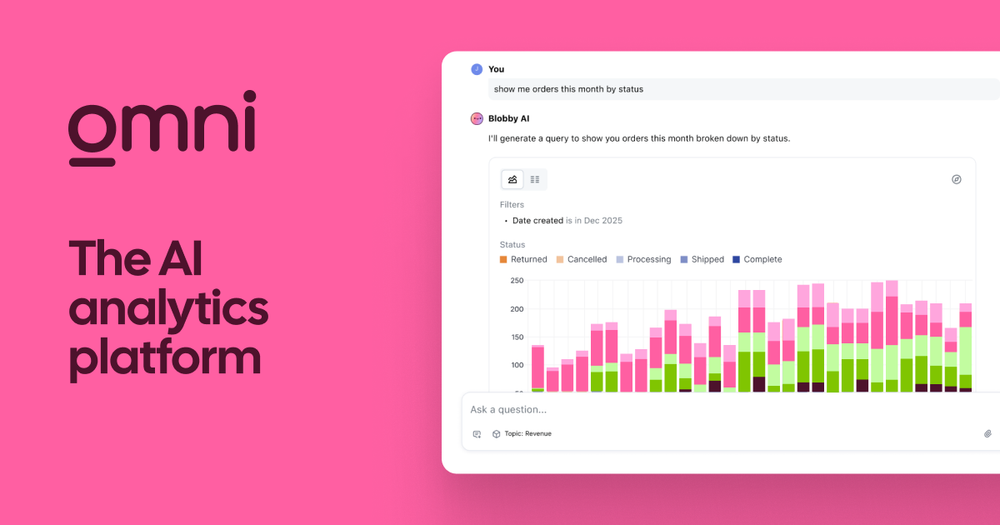
Governed BI where the AI emits semantic queries Omni compiles to SQL, with bi-directional dbt sync and published AWS and Azure hosting regions.
Data teams that already maintain dbt models and want chat, dashboards and ad hoc workbooks reading one shared semantic layer instead of three. The three-layer design - raw database, governed model, ad hoc workbook - lets an analyst answer a question in a workbook and then promote that logic back into the shared model, which is the job if your problem is definition drift rather than chart-building. Also the stronger pick of this set for a buyer with a hosting constraint, since Omni publishes its region list: AWS in the US, Canada, the EU, Australia and India, and Azure in the US, the UK and Australia, with EU users served by EU-deployed models.
Omni publishes no pricing at all - omni.co/pricing returns 404, there is no plans page, and every call to action routes to a demo or an unspecified-length free trial, so you cannot budget without a sales call. It also publishes no accuracy figure: the AI page offers Evals, where a built-in judge scores each response pass or fail, which is a harness you populate rather than a result, and the only accuracy language on the page is a customer quote with no number attached. The governed behaviour everyone buys it for is work you do first - topics and fields must be scoped, instructions and AI context added per dataset, and Evals run before you publish. And read the LLM data flow: query generation shares only metadata such as field names, filters and topic names, but result summarisation sends the result set to the model and Omni retains those summaries for 30 days.
Pros
Cons
No. omni.co/pricing and omni.co/plans both return 404, there is no plans table on the site, and every call to action routes to a demo or a free trial with no stated length. Omni's own comparison articles describe per-seat licensing with viewer and editor tiers as its model and state that enterprise pricing requires a sales conversation, but they publish no rates at all.
The AI generates semantic queries against Omni's semantic layer, which Omni then compiles to SQL, rather than writing raw SQL. Topics and fields scope what it can reach, row-level filters and user attributes apply to AI queries, and teams add instructions and AI context per dataset. Evals let a built-in judge score responses pass or fail before you publish model changes. Omni publishes no accuracy percentage.
It depends on the task. For query or formula generation, Omni states only metadata goes out - field names, filters, topic names, sorts and limits - with no private, relational or result-set data. For summarising results, the query result set is shared with the model but stays within AWS, and summaries are retained for 30 days. Omni states data sent to LLMs is not used for training.
Omni documents 15 connection types, 11 of which can be set up from a single connection string: Redshift, ClickHouse, Databricks, Exasol, MariaDB, Microsoft Fabric, SQL Server, MySQL, PostgreSQL, Snowflake and StarRocks. BigQuery, Athena, MotherDuck and Starburst Galaxy need standard setup. The Create Connection API additionally lists oracle, sap_hana and databricks_lakebase dialects, and the dbt integration is bi-directional.
Facts sourced from the vendor’s own site, last verified 2026-10-10.
The Weekly Source
One email a week. New listings, repriced tools, and the ones we would skip - including this one if its pricing changes.