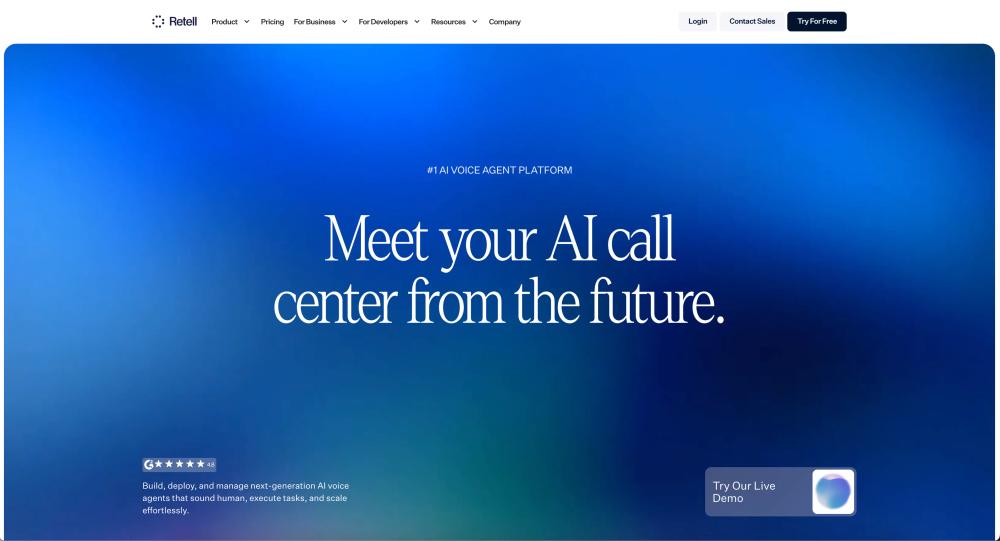
Voice agent platform with a fully itemised bill: $0.055/min voice engine plus separately priced TTS, LLM, telephony and per-minute feature add-ons.
Teams that want to tune cost against quality line by line, because Retell publishes a per-minute rate for every component and for dozens of named LLMs, from $0.0016 a minute for a nano model to $0.16 for a frontier one. It fits contact-centre and SIP-first deployments: the docs provide elastic SIP trunking guides for Twilio, Telnyx and Vonage, and named guides for Avaya, Genesys Cloud, Five9 and Amazon Connect. The 20 free concurrent calls on pay-as-you-go make it unusually generous for load testing before any contract.
Anyone who needs a single predictable rate will struggle: the published all-in band is $0.07-$0.31 a minute, and a speech-to-speech model alone is $0.345-$0.38 a minute before telephony. Feature add-ons stack per minute on top of that, each small and each permanent: knowledge base +$0.005, advanced denoising +$0.005, safety guardrails +$0.005, PII removal +$0.01, AI quality assurance $0.10 after the first 100 minutes. Retell also states that silence and hold time are billed because speech-to-text stays active, and Retell-managed numbers cover only the US and Canada, so anywhere else means bringing your own carrier over SIP.
Pros
Cons
Retell publishes a $0.07 to $0.31 per minute band because the components are billed separately. A typical build adds $0.055 for the voice engine, $0.015 or more for TTS, a per-minute LLM rate between $0.0016 and $0.16 depending on model, and $0.015 for telephony unless you bring your own SIP trunk. Feature add-ons then stack on top per minute.
Yes. The homepage states a latency of roughly 600ms and says the speech-to-text-and-back pipeline runs in about 600ms. It also claims independent benchmarks confirm Retell as the leader in responsiveness, but names no benchmark and gives no supporting numbers, so the 600ms figure is the only concrete latency claim on the site.
Yes. Retell's pricing page states that silence and hold time are billed because speech-to-text stays active throughout. Failed calls are not billed, and voicemail is billed only while the agent is active on the line. After a transfer, billing stops for the AI agent but telephony keeps charging for the remainder of the transferred call.
It depends on the providers behind the agent rather than a single platform number. The docs publish per-provider language tables for TTS and speech recognition, and note that the legacy Multilingual preset covers only ten languages: English, Spanish, French, German, Hindi, Russian, Portuguese, Japanese, Italian and Dutch. For new agents the docs recommend selecting specific languages, since narrower sets are more accurate.
Facts sourced from the vendor’s own site, last verified 2026-10-10.
The Weekly Source
One email a week. New listings, repriced tools, and the ones we would skip - including this one if its pricing changes.