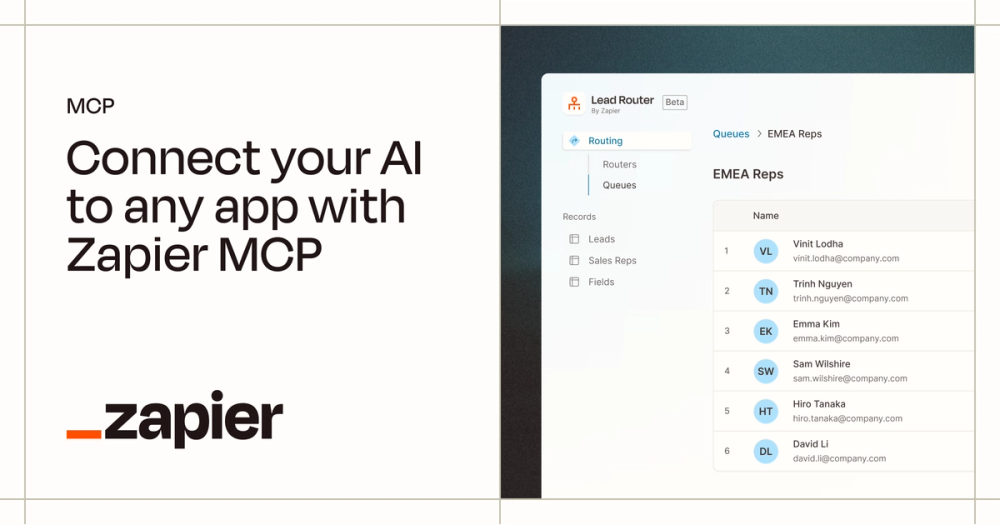
Hosted MCP server exposing your connected Zapier apps as agent tools over Streamable HTTP, metered at two Zapier tasks per successful tool call.
Builders who want the widest app surface fastest and are already paying for Zapier. The MCP page cites 9,000+ apps and 66,000+ triggers and actions, and tools are discovered at runtime through meta-tools (discover_zapier_actions, enable_zapier_action) rather than hard-coded, so one endpoint covers a long tail of apps you would never integrate by hand. It fits internal assistants and ops agents where the credentials are the company's own and the work is low-volume per call, such as filing records, sending messages or updating a CRM.
High-volume agents and anyone doing unit-economics maths should walk away: the docs state each successful tool call uses two tasks from your plan, so the Free plan's 100 tasks a month is 50 tool calls, and a Pro plan at $19.99/mo annual buys 750 tasks, meaning 375 calls. There is no self-host option and no source — this is a closed hosted service, so if you need the gateway inside your own VPC it is out. It is also the wrong shape for multi-tenant products: Zapier states only apps connected to your own Zapier account are available to the agent, and the only alternative to in-client OAuth is a long-lived connection token tied to one server that the docs explicitly warn you never to distribute.
Pros
Cons
Yes, and it is the default. You add Zapier as a connector in your MCP client, sign in, and Zapier creates and configures the server during that sign-in. The alternative is a connection token, used for code-based integrations and clients not listed in the docs. Zapier warns that a connection token is long-lived, tied to one server, and should never be distributed, since it allows running the server's tools.
MCP itself is included in every Zapier plan, but each successful tool call consumes two tasks from your plan's quota; failed calls do not count. That makes the Free plan's 100 tasks a month equal to 50 tool calls. Pro at $19.99/mo billed annually includes 750 tasks, so 375 calls. Work out your expected call volume against the task tiers before committing.
No. Zapier MCP is a closed hosted service running at mcp.zapier.com, and Zapier publishes no source or self-host deployment path for it. Your MCP client connects to Zapier's endpoint over Streamable HTTP. If you need the gateway inside your own infrastructure, look at open-source options such as the Apify MCP server, the Arcade MCP Python framework, or building on the Cloudflare Agents SDK instead.
The docs state Zapier MCP works with any MCP client that supports Streamable HTTP. Named clients include Claude, Claude Code, ChatGPT, Cursor, Codex, VS Code, Windsurf, Zed, Slack, Replit, Microsoft Copilot Studio, Gemini CLI, Mistral, Manus, Warp and v0. For code, Zapier documents the Anthropic API, OpenAI API, Python and TypeScript. Clients not on the list connect using the connection-token URL path.
Facts sourced from the vendor’s own site, last verified 2026-10-10.
The Weekly Source
One email a week. New listings, repriced tools, and the ones we would skip - including this one if its pricing changes.