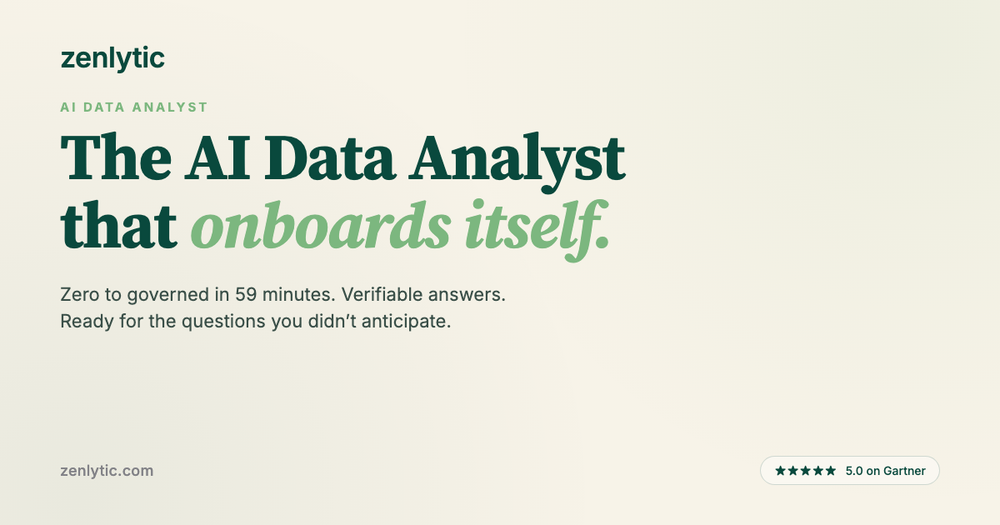
AI data analyst whose generated SQL is validated against a git-backed semantic model and row and column security before it reaches your warehouse.
Data teams being asked to point Claude, ChatGPT, Slack or Teams at the warehouse and who need every figure traceable to a human-approved field. The mechanism is the Clarity Engine, which sits between the model's SQL and your warehouse: it validates that SQL against your semantic model, enforces row- and column-level security, and marks which parts of the answer came from governed fields versus which were generated on the fly for that question. It fits a team that wants the agent to improve the context layer over time, since the agent can write back to a git-backed context layer, but only with human approval.
Zenlytic publishes no pricing and no plans - the pricing page offers only a 30-minute demo booking - and no free tier or self-serve trial, so there is no way to evaluate it without sales. It publishes no accuracy benchmark either; the 91% figure visible on the homepage is inside an illustrative admin screenshot labelled 'answered on governed fields', which is a coverage metric in a mockup, not a measured accuracy result. The dbt MetricFlow path has six documented gaps: percentile aggregations, natural-key joins, cumulative metrics, conversion metrics, the offset_window property on derived metrics, and Metric or Entity parameterised filter types. Patterns, the feature that reuses your analysts' past SQL, is in beta and supports Snowflake connections only, caps indexing at 10,000 query patterns per workspace with automatic pruning, and is useless for any question no analyst has written SQL for before.
Pros
Cons
No, and it should not be read as one. It appears inside an illustrative admin screenshot alongside a mocked count of 18,402 questions over 30 days, labelled 'answered on governed fields'. That measures how much of the question volume landed on governed definitions, not how often answers were correct. Zenlytic publishes no accuracy benchmark anywhere on its site or documentation.
Through the Clarity Engine. Every query the agent writes is validated against your semantic model and your row- and column-level security rules before it reaches the warehouse, and Zenlytic decompiles that SQL to mark which fields were human-approved versus generated for the question. Measures, dimensions and joins come from the context layer, and the agent cannot promote its own Dynamic Fields into the global model.
Nothing is published. The pricing page carries no plan names, prices, seat rates or usage rates, and its only call to action is booking a 30-minute demo. There is no free tier and no self-serve trial. The documentation confirms seats exist as a unit, with Admin, Developer and Explorer role tiers and organisation-level seat limits, but publishes no rate for any tier.
Four. The dbt MetricFlow integration excludes percentile aggregation, natural-key joins, cumulative metrics, conversion metrics, offset_window on derived metrics, and parameterised Metric or Entity filters. Patterns is Snowflake-only in beta and indexes at most 10,000 query patterns per workspace. An individual Live Query times out after about two minutes, with a one-hour rebuild timeout. Live-Query artifacts cannot be published to the web.
Facts sourced from the vendor’s own site, last verified 2026-10-10.
The Weekly Source
One email a week. New listings, repriced tools, and the ones we would skip - including this one if its pricing changes.